
A site rarely buys one kind of PPE. The same purchase order usually has to cover helmets, eye protection, respirators, hearing protection, gloves, footwear, workwear and fall arrest, often for several crews with different exposure. Split that across five suppliers and you get five lead times, five size scales and five people to chase when one carton arrives wrong.
Consolidating works, but only if the order stays legible. This is how to structure it so that one document survives contact with a factory.
Start With Protection Areas, Not Products
Buyers usually begin with a product list, because that is what the site already uses. It is the wrong starting point: a product list locks in whatever the last supplier offered, including the parts that never fitted.
Begin with the eight protection areas and mark which ones the site actually needs. Then let the model selection follow.
| Area | What triggers it | What to fix in the order |
|---|---|---|
| Head | Falling objects, electrical or thermal exposure | Impact class, ventilation, suspension type, logo position |
| Eye and face | Dust, particles, liquid splash, arc | Spectacle or goggle, lens coating, whether it fits over prescription frames |
| Respiratory | Dust, fume, vapour, oxygen deficiency | Mask class, filter type and cartridge, fit test requirement, whether supplied air is needed |
| Hearing | Noise above the action level | Attenuation rating, plug or muff, helmet compatibility |
| Hand | Cut, abrasion, chemical, heat, impact | Coating, cut level, length, grip in oil |
| Foot | Impact, penetration, slip, static, standing water | Toe cap, penetration insert, antistatic, height and size scale |
| Body | Static, visibility, weather, contamination | Antistatic grade, hi-vis class, season, laundry plan |
| Fall arrest | Work at height, open edges, ladder and tower access | Harness size and attachment points, lanyard type, anchor requirement |
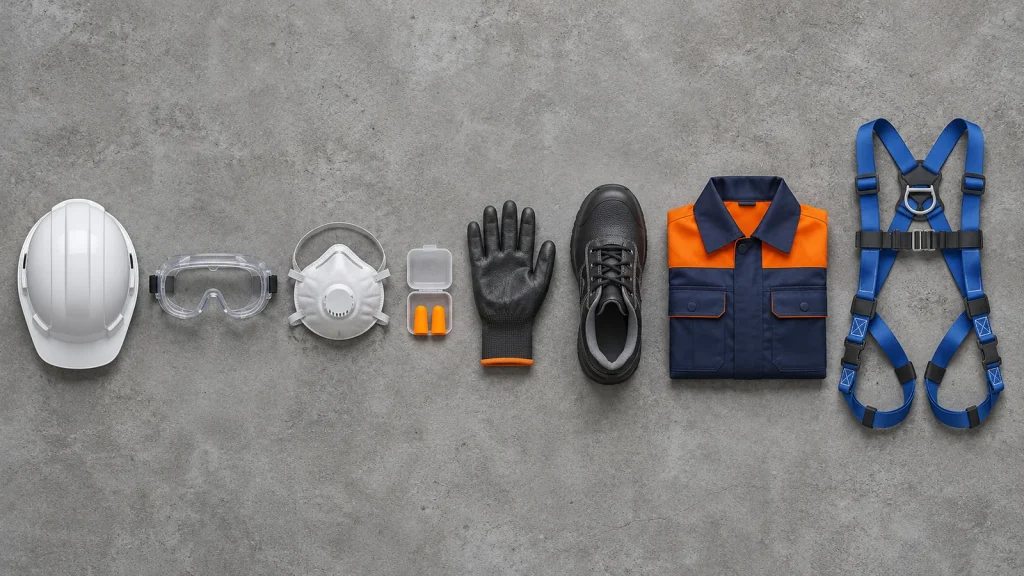
Two areas are commonly under-specified because they are bought as consumables: hearing and hand. A glove chosen on price alone usually ends up one level below the cut exposure, and ear plugs are often issued without checking the attenuation against measured noise.
Rank by Criticality, Not by Price
In a consolidated order, not every line deserves the same attention. Sort them into three groups before you send anything:
- Certified lines — anything that carries a standard claim. These need a model-level document, not a family certificate.
- Fit-critical lines — footwear, helmets and garments, where a size or shell problem stops the whole crew from wearing them.
- Repeat consumables — gloves, plugs, spectacles. These are reordered often, so consistency across batches matters more than the lowest first price.
If a supplier can only be strong in one of those groups, split the order deliberately rather than accepting a compromise everywhere.
The Four Fields That Prevent Mismatch
Most disputes in a multi-category order are not about quality. They come from four fields being left to interpretation.
| Field | Write it like this, not like that |
|---|---|
| Model | Model code plus the variant that matters — vented or not, toe cap or not, cuff length |
| Size | A size split by quantity, not a size range |
| Marking | Logo file, placement, colour and method — print, embroidery or label |
| Packing | Unit pack, inner pack, carton marking, and whether the pack is retail-ready |
“Assorted sizes” and “with logo” are the two phrases that cause the most rework. Give the split and the artwork instead.
One Document, One Version
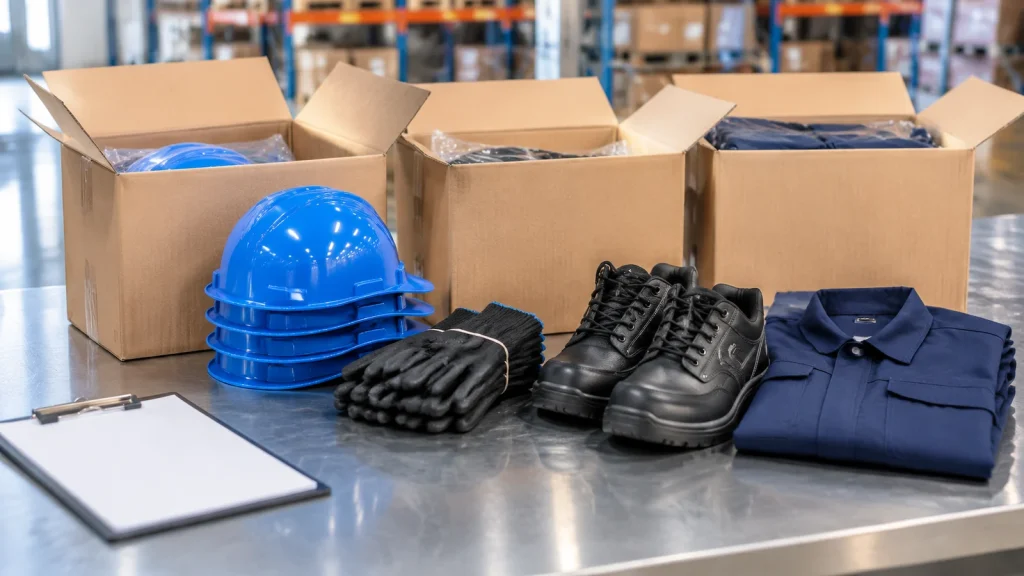
A consolidated order needs a single control document that everything else refers to. One line per model, one row of quantities per size, one column for the document reference. Emails and chat threads are negotiation, not specification.
Keep the version date on it and require written agreement before production. When a substitution is proposed later — a different shell material, a different coating, a different carton — it is a new version, not a note in a message.
What Our Range Covers
We manufacture across all eight protection areas — head, eye and face, respiratory, hearing, body, hand, foot and fall arrest — covering 30 categories and more than 1,000 specifications, so most of a site’s list can be quoted as one consolidated order rather than several. Customisation options across the line include logo printing or private label, chest embroidery, individual numbering, and colour and size splits.
The examples below show the shape of the order, not the full catalogue. Ask for the current list by protection area when you are building yours.
| Area | Example model | Where it usually sits in the order |
|---|---|---|
| Head | HXTB001 vented helmet | Certified line, summer issue |
| Eye and face | HXYM1711 chemical splash goggle | Certified line, repeat consumable |
| Respiratory | HXHX9572 half mask, single cartridge | Certified line, cartridge type must be fixed per task |
| Hand | HXSFX027 acid and alkali resistant 27 cm | Certified line, repeat consumable |
| Foot | HXZB08113 EVA low-cut safety shoe | Fit-critical line, size split required |
| Body | HX000166 pipeline antistatic suit | Fit-critical line, seasonal |
| Fall arrest | HXZL0786 full body harness | Fit-critical and certified, size and attachment points |
Send the list by protection area with quantities and size splits, and we will quote it as one order and flag any line where the specification is still open.
Multi-Category PPE Purchasing: FAQ
Is one consolidated order always cheaper?
Not automatically on unit price. It usually wins on freight consolidation, fewer inspections and one point of accountability, which is where the real cost sits.
How do I compare quotations from different suppliers?
Ask each one to quote line by line against your model and size split, with the standard and document reference stated per line. A single total is not comparable.
What if one supplier cannot cover a category?
Keep that category separate but keep the specification in the same document, so the size scale and marking rules stay consistent across both orders.
Sources
- Regulation (EU) 2016/425 on personal protective equipment — category and conformity requirements
- ISO 45001:2018, Occupational health and safety management systems — hazard identification and control of purchased goods
- NIOSH, Hierarchy of Controls — why PPE sits last in the sequence and must match the assessed hazard
Building a multi-category order? Send the protection areas, quantities and size splits, and we will quote the lines together and mark where a specification still needs a decision.