
A turnaround compresses a year of work into a few weeks, with several contractors on site at once and every one of them bringing their own PPE. That is where orders fail: not on product quality, but on quantities, sizes and paperwork that were planned for normal operations rather than for a shutdown.
This checklist works through the order in the sequence the job actually happens.
Start With the Job List, Not the PPE List
Build the order from the work that will take place, then map PPE to each task. A shutdown usually contains six work types, and each one drives a different protection set.
| Work type | Governing hazard | PPE set to plan for |
|---|---|---|
| Hot work | Sparks, molten droplets, UV and IR radiation, fume | Welding helmet with edge protection, welder’s gauntlets, heat-resistant sleeves, respirator with particulate filter |
| Confined space | Oxygen deficiency, toxic gas, entanglement | Full-face respirator or supplied air, harness with retrieval line, gas detector, anti-static clothing |
| Electrical work | Shock, arc flash | Insulating helmet, insulating gloves rated for the voltage, arc-rated face shield, insulating footwear |
| Height and access | Falls from scaffolding, ladders, vessel tops | Full-body harness, lanyard or fall arrester, helmet with chin strap |
| Cleaning and chemical | Splash, vapour, skin contact | Chemical gloves matched to the medium, splash goggles, chemical-resistant boots, apron or coverall |
| General site work | Impact, cuts, noise, dust | Safety helmet, safety glasses, cut-resistant gloves, safety shoes, ear plugs or muffs |
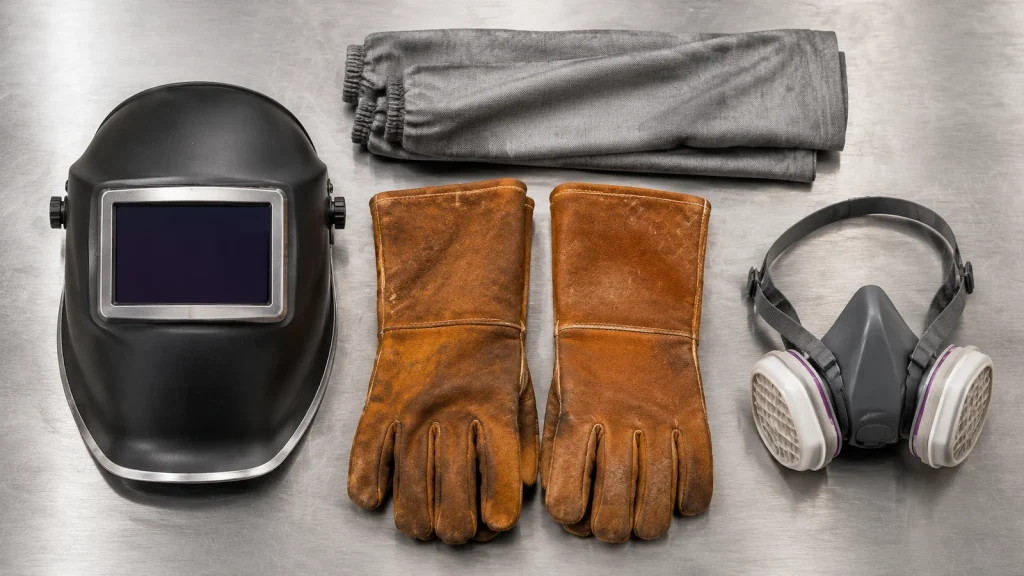
The rows overlap on purpose. One worker on hot work inside a vessel needs the confined-space set and the hot-work set at the same time, and both have to be compatible — a welding shield that does not fit over a respirator is a gap, not a substitution.
What Goes Wrong at Scale
Four failures account for most turnaround PPE problems.
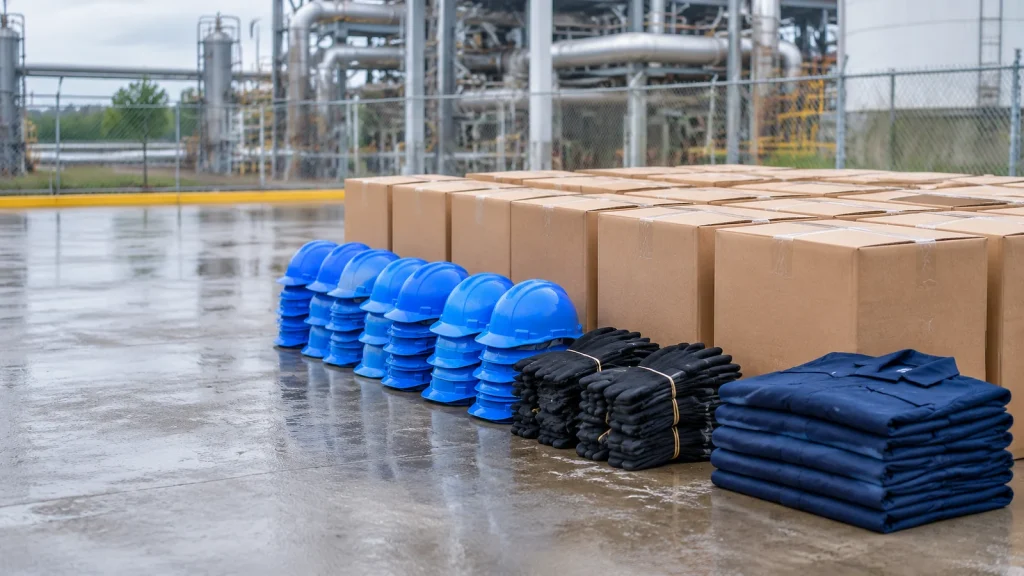
Sizes are planned from a headcount, not a distribution. Two hundred workers is not forty of each size. Ask each contractor for a size sheet before the order is placed, and expect the middle sizes to run out first.
No spare pool. Gloves, glasses and ear plugs are consumed at a rate that surprises people during a shutdown. Budget a replacement margin rather than ordering to the exact headcount.
Mixed batches. When the same glove is ordered from two sources, one crew gets a different fit and the complaint lands on the whole supply. Keep one specification per line for the duration of the shutdown.
Arrival inspection skipped. Cartons are opened on the first morning of the shutdown and a size or a standard is wrong. Inspect and count before the site goes into shutdown mode.
Quantities: How to Size the Order
Build each line from three figures rather than from a total:
- Wearers — people who need the item, by size, including contractors
- Issue rate — how many units per person the task consumes across the shutdown
- Duration — the planned shutdown length, plus the ramp-up and demobilisation weeks
Then add a replacement margin on the consumable lines. Durable items — harnesses, full-face masks, insulating gloves — are sized to headcount plus a small reserve for damage, not to a consumption rate.
Tagging and Issue Control
A shutdown brings people who have never worked on this site. Individual marking is the cheapest control available: a name or employee number on the garment and the helmet tells you who is wearing what, and makes retrieval possible after the shutdown ends.
Ask for individual numbering and name marking at the order stage. Adding it after delivery is a second production run.
What to Send With the Enquiry
| Item | Detail to supply |
|---|---|
| Work list | The six work types above, with the areas and the contractor count for each |
| Size distribution | Quantities by size per contractor, not a total |
| Shutdown window | Start, end, and the delivery date you actually need on site |
| Marking | Logo artwork, placement, individual numbering or name marking |
| Standards | Standard per line, and whether the document has to travel with the carton |
| Packing | Whether cartons are split by area or by contractor on arrival |
With those six, a quotation can be built line by line and checked against the shutdown plan before anything is produced.
Examples From Our Range
The items below are examples of the categories a shutdown draws on rather than the full list, which runs across all eight protection areas.
- Anti-static workwear in red, grey and blue — the colour set used in refinery and pipeline operations
- Insulating safety helmets for electrical tasks
- Impact and penetration resistant safety shoes for general site work
- Aluminium-edge welding shields for hot work
- Insulating gloves graded for the working voltage
- Full-body harnesses and Fall arrest lanyards for height work
Tell us the work list and the size split, and the order is quoted as one shipment with the lines marked by work type.
Refinery Turnaround PPE: FAQ
How far ahead should a shutdown PPE order be placed?
Long enough for marking and size correction before the shutdown starts. Marked garments and non-stock sizes are the two items that cannot be compressed at the end, so confirm them first.
Can contractors use their own PPE?
Only if it matches the site specification. Mixed sources usually means mixed standards and no record of what was issued to whom, which is the part an investigation asks for later.
What is most often under-ordered?
Consumables in the middle sizes — gloves, glasses and ear plugs — and spare cartridges for respirators.
Sources
- Regulation (EU) 2016/425 on personal protective equipment — conformity and documentation requirements
- OSHA 29 CFR 1910.146, Permit-required confined spaces
- OSHA 29 CFR 1910.269 and NFPA 70E — electrical protective equipment and arc-rated PPE
- ISO 45001:2018 — control of contractors and purchased services
Planning a shutdown order? Send the work list, the size split by contractor and the date it has to be on site, and we will quote it line by line with the marking and packing already specified.