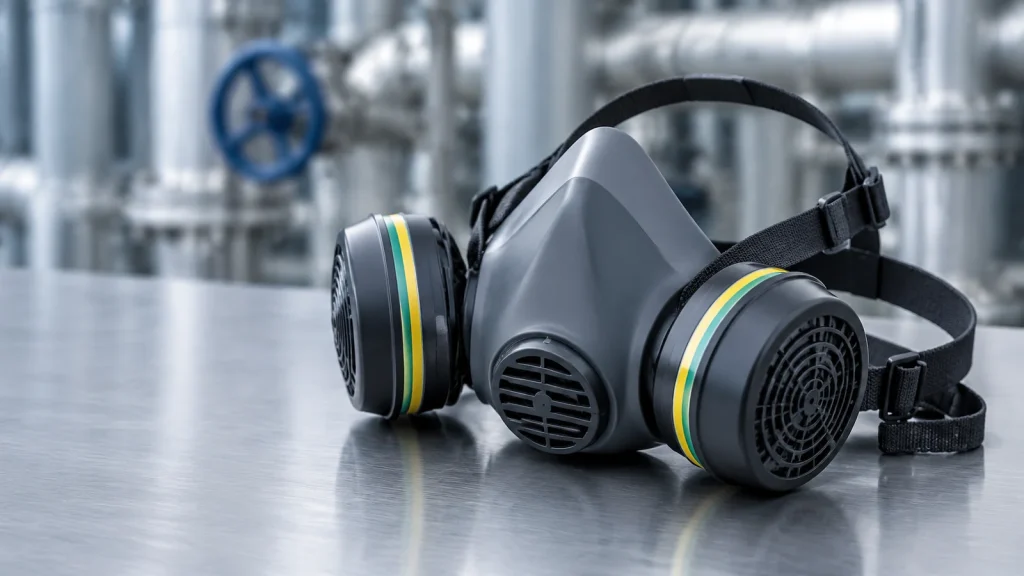
Respiratory protection is the one PPE category where choosing the wrong product does not simply reduce protection — it produces a false sense of it. A worker wearing the wrong cartridge against hydrogen sulphide has no warning signal: no smell once the filter is saturated, no visible change, no discomfort.
That is why the sequence matters. Decide first whether a filter respirator is acceptable at all, then which cartridge, then which mask.
When a Filter Respirator Is the Wrong Answer
A filter respirator purifies the surrounding air. It cannot add oxygen, and it cannot cope with a concentration that overwhelms the filter.
It is the wrong choice in four situations:
- Oxygen deficiency — confined spaces, tanks, pits and trenches. No cartridge supplies oxygen.
- Unknown concentration — if nobody has measured it, nobody can select a filter for it.
- IDLH atmospheres — immediately dangerous to life or health. Supplied air or self-contained breathing apparatus only.
- Hydrogen sulphide at high concentration — H₂S deadens the sense of smell at exactly the concentrations where it becomes dangerous, so the body provides no warning.
For tank entry, plant rescue and leak response, the answer is positive-pressure supplied air, not a better cartridge. Getting this boundary right matters more than any specification further down the page.
Read the Hazard, Then the Cartridge
Filter cartridges are classified by the gas family they remove. Selecting by colour alone is unreliable across brands; selecting by class is not.
| Class | Removes | Typical petrochemical source |
|---|---|---|
| A | Organic vapours and gases | Hydrocarbon vapour, solvents, sampling points |
| B | Inorganic gases | Hydrogen sulphide, chlorine, hydrogen cyanide |
| E | Acidic gases and vapours | Sulphur dioxide, hydrogen chloride, acid mist |
| K | Ammonia and organic ammonia derivatives | Amine units, ammonia handling |
| P3 | High-toxicity particulate | Catalyst dust, welding fume, aerosols |
Mixed exposure is the normal case, not the exception. A combined cartridge — A with P3, for example — is what a refinery sampling job usually needs, because the vapour and the particulate arrive together.
Half Mask or Full Face: What Actually Changes
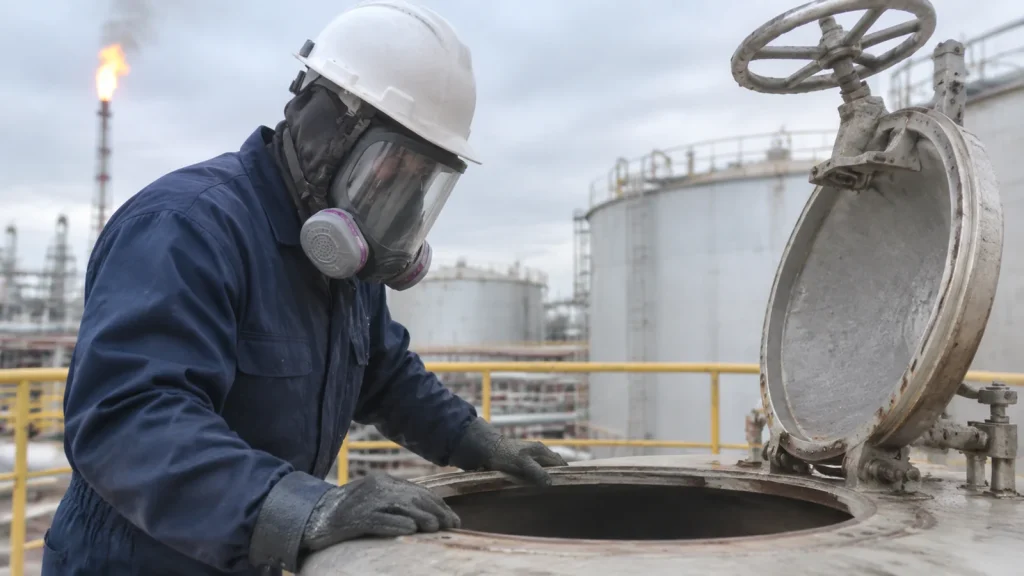
Both use the same cartridge logic. The difference is the seal and the eyes.
A half mask leaves the eyes uncovered, so eye protection has to be specified separately — and spectacle arms crossing the mask edge are a common cause of leakage. A full-face mask seals around the whole face, protects the eyes against vapour and splash, and is held to a tighter leakage requirement in testing.
For tank and confined-space work, and for rescue, full face is the starting point. For routine sampling and short tasks, a half mask is lighter and more comfortable over a shift, which in practice means it is worn correctly for longer.
Why Dual Cartridge Suits Continuous Work
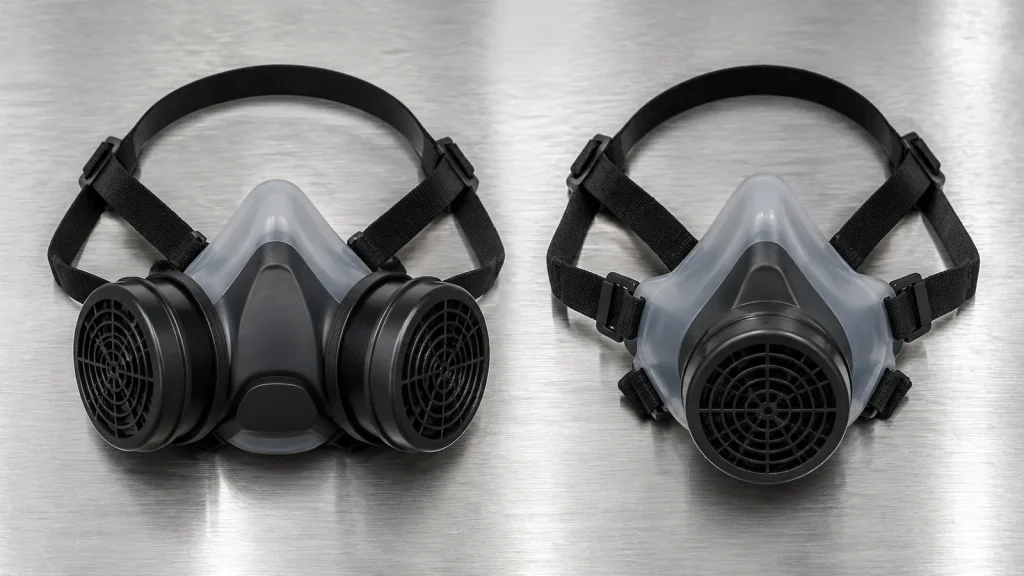
Two cartridges double the filtration area. The practical result is lower inhalation resistance, which the wearer experiences as less effort per breath and less fatigue across a shift.
Balance matters as much. A dual-cartridge mask distributes weight to the sides of the face instead of pulling forward on the nose bridge, and a low-profile body lets the wearer look down at the work and wear goggles or a welding shield without a blind spot. A downward-facing exhalation valve keeps the face drier in hot plant areas.
Fit Decides Whether Any of It Works
Every number on a datasheet assumes the mask seals. Facial hair at the sealing surface, a wrong size, or a strap adjusted too loosely breaks the seal, and the wearer will not feel it.
Three things follow: specify by face size rather than one universal size, run a fit check every time the mask is donned, and use a formal fit test where the site requires it. A mask that seals well on a test panel may still leak on a particular wearer.
Examples From Our Respiratory Line
The four below are examples rather than the full list; the range also covers valved KN95 styles, cup-type versions and additional cartridge combinations.
| Model | Type | Where it fits |
|---|---|---|
| HXHX9848 | Dual-cartridge half mask, medical-grade TPE, 135 g | Continuous work: petrochemical, spray painting, reactor maintenance |
| HXHX9596 | Full-face mask, food-grade silicone, anti-fog PC visor, speech diaphragm | Tank and confined space, acid vapour, plant rescue |
| HXHX9572 / HXHX9573 | Single-cartridge half mask, TPE or silicone, threaded port | Short tasks with one known medium: acid pickling, cleaning, fumigation |
| HXHX9559 | KN95 folding mask with coconut-shell carbon layer | Dust with mild odour — not a substitute for a gas cartridge |
Cartridges come as a bayonet-fit series covering classes A, B, E, K and P3, so a mask body can be matched to the medium rather than replaced entirely when the hazard changes.
The respiratory series is built to GB 2626-2019 and GB 2890-2022, benchmarked against EN 149 and EN 136. Filter efficiency and breathing resistance figures for each model are available on request; on the KN95 range the measured particle filtration efficiency at 85 L/min sits in the 98.2–99.1% band, and inhalation resistance is held at or below 120 Pa against a 210 Pa limit.
Petrochemical Respirators: FAQ
Can a cartridge filter be used against hydrogen sulphide?
Only where the concentration is known, measured, and below the level at which the atmosphere becomes immediately dangerous, and only with continuous monitoring. In any IDLH situation, including tank entry and leak response, use supplied air.
How often should a cartridge be replaced?
On breakthrough, on the manufacturer’s stated service life, or when the odour or taste of the medium appears — whichever comes first. Cartridges also have a shelf life and a limited life after the seal is opened.
Is a KN95 mask enough for organic vapour?
No. A standard KN95 filters particles only. Carbon-layer versions reduce mild odour and are still not gas cartridges, and neither is a substitute for a filter selected by gas class.
Sources
- GB 2890-2022, 呼吸防护 自吸过滤式防毒面具 — 全国标准信息公共服务平台
- GB 2626-2019, 呼吸防护 自吸过滤式防颗粒物呼吸器
- EN 136:1998, Respiratory protective devices — Full face masks; EN 149, Filtering half masks
- OSHA 29 CFR 1910.134, Respiratory protection — fit testing and IDLH provisions
Working through a gas list for a petrochemical site? Send the media, the measured concentrations and the task duration, and we will confirm which cartridge class applies — and tell you plainly when the answer is supplied air rather than a filter.