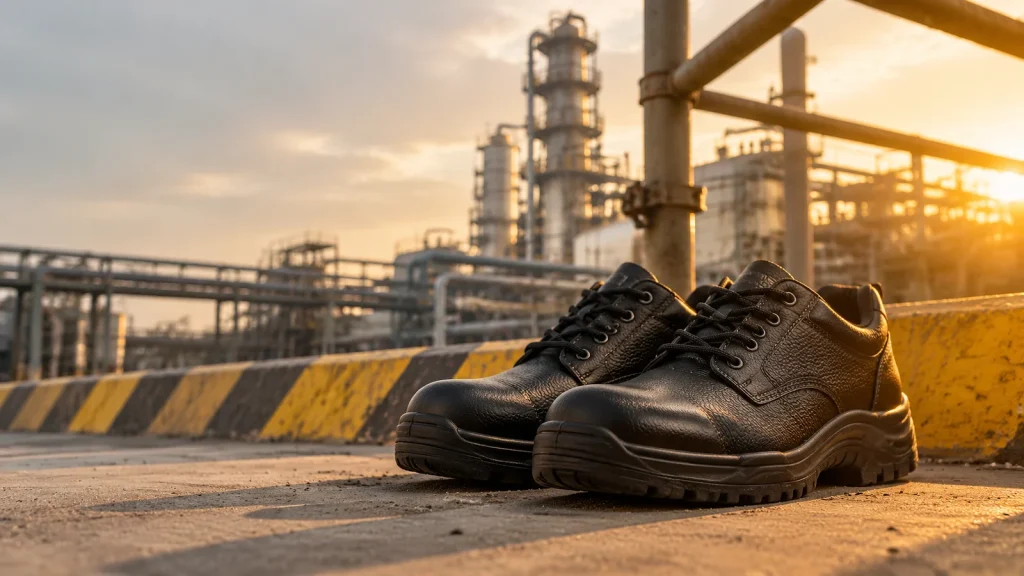
Antistatic footwear is usually bought as a single figure: a resistance value printed on a datasheet. That figure only means something if it was measured on the right thing, and if the floor, the socks and the wear pattern do not quietly defeat it.
Three properties get confused in one conversation: antistatic, conductive and insulating. They are not points on one scale, and they are not interchangeable.
Three Different Jobs
| Property | Resistance band | What it is for |
|---|---|---|
| Antistatic | Roughly 10⁵ to 10⁹ ohm | Bleeds static off the wearer slowly enough that no spark forms, while still limiting current through the body |
| Conductive | Below the antistatic band, down to 10⁴ ohm or lower | Very fast discharge in areas where even a small spark is unacceptable — and never near live electrical work |
| Insulating | Far above the antistatic band | Protection against electric shock for live working — the exact opposite requirement to antistatic |
The practical consequence is simple and often missed: insulating footwear must never be used as antistatic footwear, and antistatic footwear must never be used for live electrical work. One traps charge, the other releases it. A site that buys on price alone can end up with the wrong one of the two.
Why the Range Has a Floor as Well as a Ceiling
Most buyers check only the upper limit. The lower limit matters just as much.
If resistance is too high, the wearer accumulates charge and the discharge happens later — at a door handle, at a valve, at the moment of contact with earthed metal. If resistance is too low, the body becomes a better conductor than it should be, and a fault current has an easier path through the wearer.
Antistatic footwear deliberately sits in the middle. It is a compromise between dissipating charge and limiting current, which is why a shoe quoting an extremely low resistance is not automatically a better product — it may be the wrong class for the job.
The Shoe Is Only One Part of the Circuit
Antistatic footwear works as part of a system: shoe, floor, and the wearer. All three have to co-operate.
- Floor. A dissipative sole on an insulating floor has nowhere to send the charge. Concrete is usually acceptable; sealed epoxy, dry rubber matting and some tiles are not.
- Socks. Thick synthetic socks, or two pairs, add resistance between the foot and the insole and can push the wearer outside the band.
- Insole. Replacing the original insole with a comfort insole — often an insulating foam one — is one of the most common ways a compliant shoe stops being compliant.
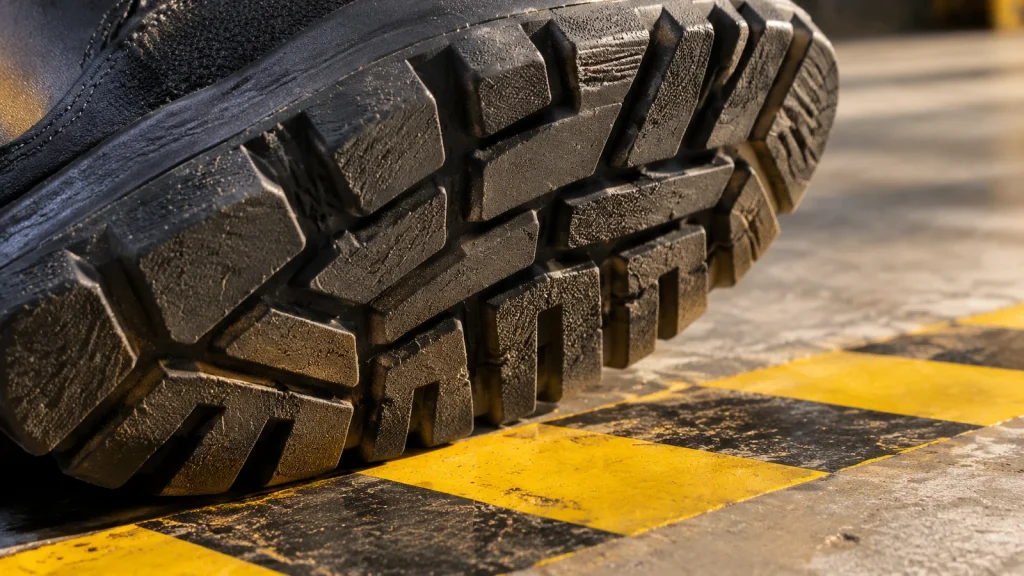
- Wear and contamination. A build-up of dried paint, resin or heavy grease on the sole insulates it. So does a rubber overshoe used for wet areas.
This is why antistatic performance should be checked on the wearer and in place, not only on a sample in a laboratory.
Reading the Number: Measured How?
Two resistance figures can describe the same shoe and mean different things: resistance of the footwear alone, measured on a plate, and resistance of the wearer plus footwear, measured in the working position. The second is the one that reflects the job.
Ask which one the report states, and whether the measurement was taken with the shoe as supplied — original insole, dry, uncontaminated. A figure without that context cannot be compared with another supplier’s figure.
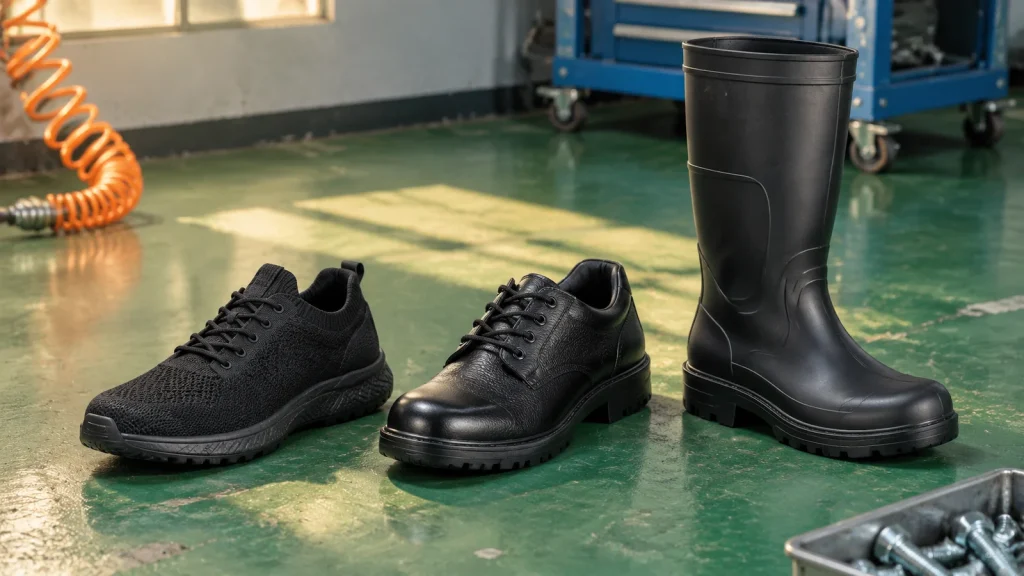
Examples From Our Antistatic Footwear Line
The styles below are examples rather than the full list. All models in the antistatic range are specified in the 10⁵–10⁹ ohm band, in low-cut, high-cut and rubber boot versions.
| SKU | Style | Where it suits |
|---|---|---|
| HX000133 | Flyknit low-cut, PU or rubber outsole, Kevlar penetration plate | Warm plant areas, long shifts, light weight priority |
| HX000143 | Smooth full-grain leather, rubber outsole | Oil and dust — leather wipes clean where mesh holds contamination |
| HX000144 | Perforated full-grain leather for airflow | Hot indoor work where mesh is not acceptable |
| HX000162 | High rubber boot, antistatic and oil resistant | Washdown, standing liquid, tank bunds |
| HX000163 | Mid-height rubber boot, antistatic and oil resistant | Wet areas where a full boot is too much |
Tell us the floor type, the sock policy and whether the site measures wearer resistance in place, and we will quote the model that suits that combination rather than the cheapest style in the band.
Antistatic Safety Footwear: FAQ
Can antistatic shoes be worn for electrical work?
No. Antistatic footwear is designed to conduct a small amount of charge away from the body, which is the opposite of what insulating footwear does. Live working requires insulating footwear rated for the voltage.
Why does my shoe pass in the factory but fail on site?
Usually the floor, the socks, an aftermarket insole, or contamination on the sole. The shoe has not changed; the circuit around it has.
Is a lower resistance always better?
No. Below the antistatic band the footwear becomes conductive, which is a different class intended for a different hazard and not for general plant use.
Sources
- GB 21148-2020, 足部防护 安全鞋 — 全国标准信息公共服务平台
- EN ISO 20345, Personal protective equipment — Safety footwear; antistatic and conductive requirements
- EN 50321 series, Electrically insulating footwear for working on low voltage installations
Specifying antistatic footwear for a plant area? Send the floor type, the sock requirement and the resistance band the site measures, and we will confirm which models are specified in that band.