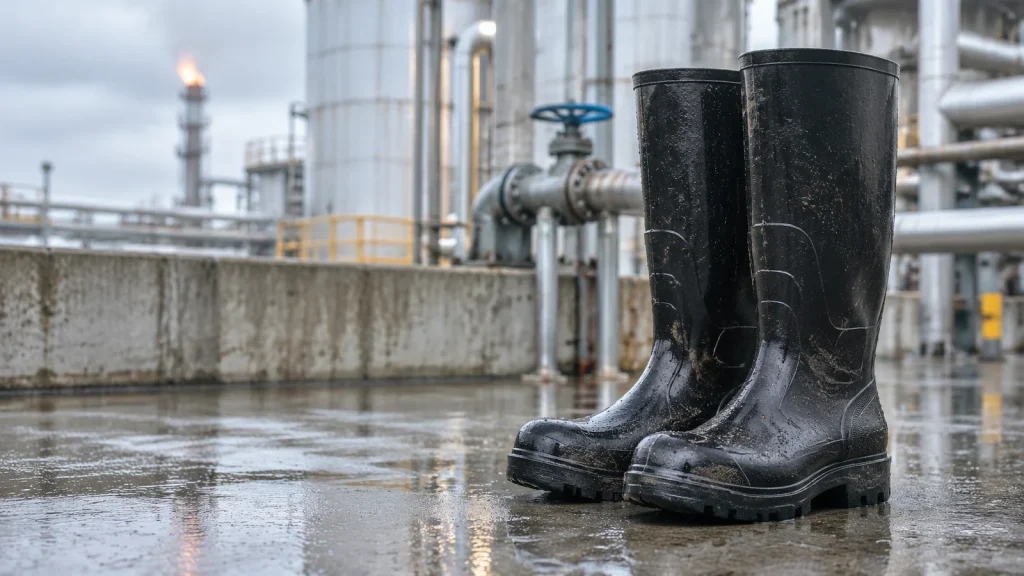
“Acid and alkali resistant” appears on almost every chemical boot datasheet. It names no chemical, no concentration, no temperature and no duration — so it cannot be verified, and it cannot be compared between two suppliers.
A reagent-specific claim reads differently: it names the media and the concentration the material was actually tested against. This guide shows what that claim looks like, why concentration changes the answer, and what to send your supplier before a purchase order.
Why “Acid and Alkali Resistant” Is Not a Chemical Resistance Rating
Three problems sit behind the phrase.
It hides concentration. Dilute and concentrated forms of the same acid attack different polymers at different rates. Sulphuric acid at 10% and at 96% are not the same exposure, and a material that survives one may swell, embrittle or fail in the other.
It hides duration. A ten-second splash and an hour standing in a spill are different test conditions. A boot that resists splash may still let a medium through during prolonged contact.
It hides the rest of the boot. A chemical boot is a system: outsole compound, upper material, seams and stitching. The compound may resist a reagent while the seam adhesive does not, and the seam is where liquid collects.
A usable claim reads like this: upper and outsole treated for resistance to sodium hydroxide 40%, sulphuric acid 96%, and nitric acid 65±3%. That sentence names the media, the concentration, and that the treatment covers both upper and outsole. It is also falsifiable — you can ask for the report page where those three reagents appear.
How Concentration and Temperature Change Chemical Resistance
There is no rule of thumb that survives a real reagent list.
For some polymers a concentrated acid passivates the surface while a dilute one penetrates faster. For others the reverse holds. This is exactly why the test has to name the concentration rather than the chemical family, and why “resistant to acids” cannot be transferred from one reagent to another within the same group.
Temperature compounds the problem. A medium that is compatible at ambient temperature may attack the same material in a heated washdown or a steam-cleaned area. If the boot is used in a hot zone, the test temperature has to match the service temperature, not the laboratory’s default.
Two further variables matter as much as the reagent itself: whether contact is splash or immersion, and how long the contact lasts per shift. A boot specified for splash duty is not a boot specified for standing liquid, and the difference shows up in the field as a seam failure rather than a material failure.

Choosing Chemical-Resistant Safety Boots by Work Zone
| Zone | Typical exposure | What to specify |
|---|---|---|
| Tank farm and bund area | Splash from stored product, occasional spill | Chemical-resistant upper and outsole, antistatic sole, slip-resistant tread |
| Loading gantry | Short-duration splashes, continuous movement | Chemical resistance plus ankle support and a cleated outsole |
| Washdown and decontamination | Standing liquid, repeated wetting | Full rubber boot with whole-boot water resistance, not a coated shoe |
| Laboratory and sampling points | Small-volume drips, mixed reagents | Chemical resistance plus a smooth, cleanable surface |
| Maintenance and shutdown | Mixed media, sharp debris | Chemical resistance plus toe cap and penetration-resistant sole |
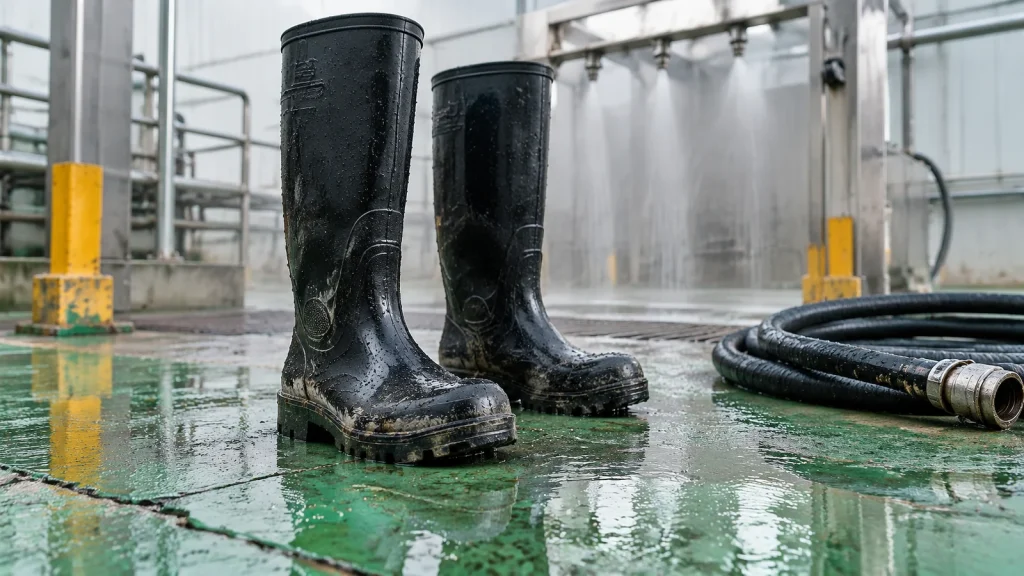
A coated safety shoe is often adequate at a gantry. It is the wrong choice for standing liquid, where the liquid enters over the top of the shoe rather than through the material. Matching the boot type to the zone removes more risk than upgrading the compound.
What Else a Chemical Safety Boot Must Do
Chemical resistance is one requirement among several, and buyers routinely let it crowd out the others.
A 200 J toe cap is still required for falling objects — a chemical boot without a toe cap is not a safety boot. Penetration resistance still matters, because nails, glass and swarf do not disappear on a chemical site. Slip resistance still matters, because chemical spills are wet by definition. Antistatic behaviour has to sit inside the specified resistance range where flammable atmospheres exist. And the compound has to hold its integrity after exposure: a boot that resists a reagent but hardens and cracks within two weeks is not protection.
None of these properties follows from chemical resistance. Each has to be specified and evidenced separately.
Chemical-Resistant Boot Specification: What to Send Your Supplier
Copy this into your enquiry. It removes almost all of the back-and-forth.
| Field | What to write |
|---|---|
| Reagents | Every chemical the boot contacts, by proper name |
| Concentration | Actual working concentration as a percentage |
| Temperature | Service temperature at the point of contact |
| Contact type | Splash, immersion, or standing liquid |
| Duration | Typical and worst-case exposure per shift |
| Other hazards | Falling objects, penetration, static, heat, slip |
| Standard required | GB 21148-2020, EN ISO 20345, or both — stated separately |
| Volume and sizes | Pairs by size, plus replacement cycle |
If the supplier answers “yes, acid resistant” without asking for the concentration, that answer is not usable.
Our Chemical-Resistant Safety Boot: HXZB0919
HX000159 / HXZB0919
| Property | Detail |
|---|---|
| Reagent resistance | Upper and outsole treated against sodium hydroxide 40, sulphuric acid 96, nitric acid 65±3% |
| Toe protection | 200 J toe cap |
| Standard | GB 21148-2020 |
| Upper and sole | Chemical-resistant compound with cleated tread |
Two honest notes on this table. The reagent figures are recorded in our internal specification; confirm the concentration units and the test temperature against the report before writing them into a tender document. And because chemical resistance is a per-medium result, this boot is quoted against a reagent list rather than against the word “acid” — send your media and we will confirm coverage from the report, or state plainly that a medium falls outside the tested range.
For sites that need the same chemical duty in a full rubber boot, see our antistatic rubber boots range. Where splash gloves are part of the same kit, the matching specification logic is covered in EN 374 chemical protective gloves.
Chemical-Resistant Safety Boots: FAQ
Is “acid and alkali resistant” safe for any acid?
No. Without a named medium and concentration there is nothing to verify, and resistance to one reagent does not transfer to another.
Is a chemical boot also an antistatic boot?
Only if antistatic performance is separately specified and tested. Chemical resistance and electrical resistance are independent properties, and one does not imply the other.
Do seams and stitching count as part of the barrier?
Yes. Ask whether the reagent test covers the assembled boot or only the flat material, because seams and adhesives are the usual failure point.
How often should chemical boots be replaced?
When the surface shows swelling, hardening, cracking or colour change, or when the tread is worn smooth. Chemical degradation usually starts before any visible damage, so inspection should be scheduled rather than reactive.
Sources
- EN ISO 20345, Personal protective equipment — Safety footwear
- EU-OSHA, Regulation (EU) 2016/425 — personal protective equipment guidance
Looking for a quote? Send the reagent list, concentration, temperature, contact type and quantity, and we will confirm coverage against the test report for the exact model and size.