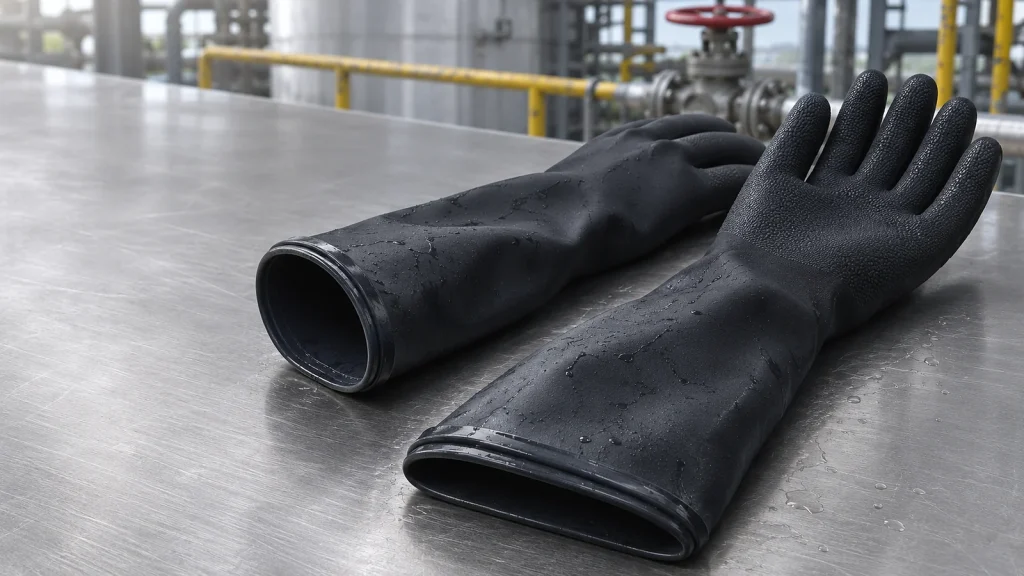
Every chemical glove catalogue says the same three words. None of them say what the glove was tested against, for how long, or at what concentration — and those three variables decide whether the glove protects a hand or merely covers it.
EN 374 replaces the phrase with something measurable. This is how to read it.
Penetration and Permeation Are Different Failures

The standard covers both, and they fail in different ways.
Penetration is a chemical passing through a physical defect: a pinhole, a crack, a badly bonded seam. EN 374-2 tests it with air and water leak checks, which is why the same check appears in production quality control.
Permeation is a chemical passing through intact material at molecular level. Nothing is visible, the glove looks perfect, and the wearer feels nothing until exposure has already happened. EN 16523-1 measures it as breakthrough time, and that measurement is what the letter code reports.
A glove that passes the leak test has not been shown to resist permeation. The two are separate results.
Type A, B, C: What the Letter Proves
| Type | Requirement |
|---|---|
| A | At least 30 minutes against at least 6 test chemicals |
| B | At least 30 minutes against at least 3 test chemicals |
| C | At least 10 minutes against at least 1 test chemical |
Type A is broader, not better. A Type C glove proven against the one chemical you actually handle can be the correct and cheaper choice, while a Type A glove may not include that chemical in its list at all. Buying on the type letter instead of the chemical list is the most common purchasing error in this category.
How to Read a Breakthrough Level
Beneath the shield pictogram sits a letter code — something like AJKL — where each letter is one of the defined test chemicals. The accompanying table gives a performance level for each, on a scale of 0 to 6.
The scale is a time scale: level 1 starts above 10 minutes, level 2 above 30 minutes, and each level above that represents a longer breakthrough time.
Read it per chemical, never in general terms. A glove at the top level against one solvent and the lowest against another is accurately described by both numbers, and two gloves carrying the same type letter can differ by several levels on the medium you actually use.
Concentration and Temperature Change the Result
Permeation depends on the concentration of the medium, not only its identity. Sulphuric acid at 96% and at 10% are different challenges to the same polymer, and a test run at one concentration does not cover the other. Temperature works the same way: a rate measured at ambient temperature understates what happens at a heated sampling point.
This is why “yes, acid resistant” is not an answer. The usable question is: at what concentration, at what temperature, and for how long was this specific glove tested against this specific medium?
Degradation Fails Gloves That Pass Permeation
EN 374-4 measures what the chemical does to the material itself — swelling, hardening, embrittlement, colour change, dimensional change. A glove can hold permeation for hours and still degrade until it splits.
In the field that shows up between the fingers and at the cuff, which is exactly where a glove flexes. Once it degrades, the permeation result stops being relevant.
What to Send Before You Order
| Field | What to supply |
|---|---|
| Chemical | Proper name, not a trade name or a chemical class |
| Concentration | Working percentage, and whether it varies through the shift |
| Temperature | Service temperature at the point of contact |
| Contact pattern | Splash, immersion, or continuous immersion |
| Duration | Time per exposure, and exposures per shift |
| Mixtures | Solvent blends behave differently from single chemicals |
| Secondary hazard | Cut, abrasion, heat, grip in oil — each needs its own standard |
Examples From Our Chemical Glove Line
The three below are examples, not the full list. The line also covers antistatic oil and acid resistant styles, extended-cuff versions and heavier latex gauntlets, in different lengths and coatings.
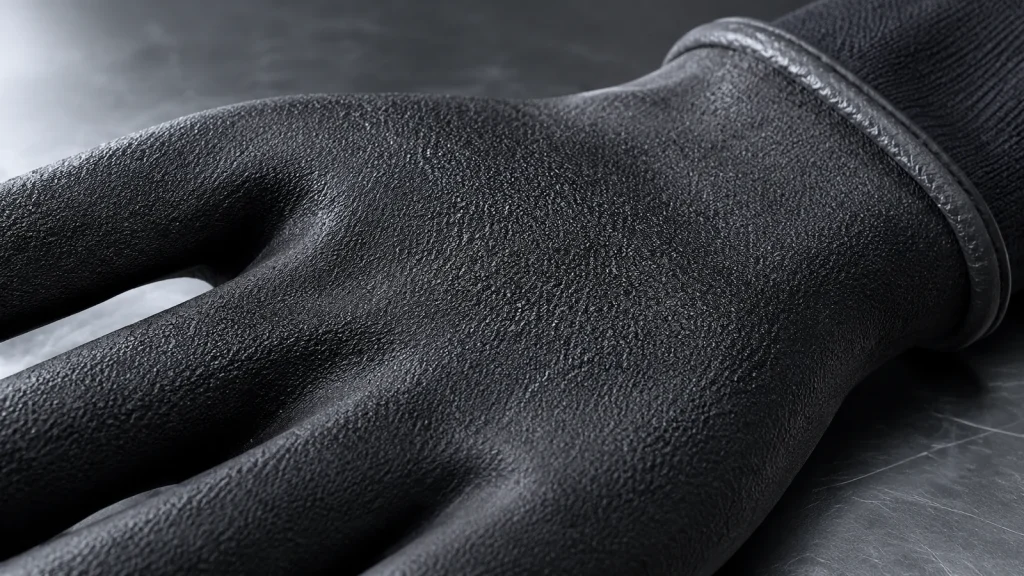
| Model | Construction |
|---|---|
| HXSFX203 | Neoprene, double dip, extended cuff, cotton lining, fine palm pattern |
| HXSFX027 | Nitrile, double dip, 27 cm length, granular grip, cotton lining |
| HXSFR031 | Latex, diamond grip, extended cuff, food contact grade |
These models are supplied against EN 374. Permeation performance is a per-medium result, so we do not publish a single figure for a model: send the media list with concentration and temperature, and we will confirm coverage against that model’s report and supply the relevant pages. If a medium falls outside the tested range, we will say so rather than answer from the label.
EN 374 Chemical Gloves: FAQ
Is Type A better than Type B?
It covers more chemicals, not more of yours. Check whether your medium appears in the letter code before comparing types.
Can EN 374 be compared with an ANSI chemical rating?
Not directly. The test methods and reporting conventions differ, so compare within one system or ask for the underlying breakthrough time.
Are chemical gloves also cut resistant?
Only if EN 388 cut performance is separately specified. Chemical resistance and mechanical resistance are independent results.
Sources
- EN ISO 374-1:2016, Protective gloves against dangerous chemicals and micro-organisms — Terminology and performance requirements for chemical risks
- EN 16523-1:2015, Determination of material resistance to permeation by chemicals
- EU-OSHA, Directive 89/686/EEC and Regulation (EU) 2016/425 — protective equipment guidance
Send your reagent list, concentrations, service temperature and required length, and we will quote the glove against those media rather than against the word “acid”.